
Paint correction restores gloss and clarity to oxidized vehicle paint by using precision machine polishers and specialized abrasive compounds to safely remove the damaged, chalky layer of clear coat. This process levels the paint surface, eliminating microscopic defects and haze so light reflects uniformly off the finish. By permanently removing surface degradation rather than masking it, professional service restores deep color depth and a mirror-like shine.
Daily exposure to ultraviolet rays, atmospheric pollution, and salt air breaks down factory clear coats over time. What starts as a loss of gloss turns into a dull exterior with swirl marks and heavy oxidation. Parking outdoors accelerates this degradation, leading many car owners to believe a respray is their only option.
Restoring factory clarity does not require replacing body panels or paying thousands for new paint. Multi-step paint correction removes surface defects, clears severe oxidation, and preserves original clear coats.
What Causes Paint Oxidation and Surface Dullness?
Modern automotive paint systems consist of a primer layer, a base color coat, and a transparent top layer known as the clear coat. The clear coat acts as a protective shield, defending the pigment underneath against UV radiation, moisture, acid rain, and environmental contaminants.
When a vehicle is repeatedly exposed to intense sunlight and harsh coastal conditions such as those experienced by daily drivers requiring paint correction in Carolina Forest, SC the clear coat begins to break down at a chemical level.
As UV rays penetrate the clear coat, they break down the polymer bonds within the finish. The clear coat becomes porous, pitted, and brittle. Microscopic cracks form across the surface, trapping dirt and moisture. Instead of allowing light to pass through cleanly and reflect off the base coat, the damaged surface scatters incoming light rays in every direction. This scattering effect is what makes your vehicle’s paint appear dull, chalky, milky, or completely flat.
How Paint Correction Mechanically Restores Clarity
Paint correction is a mechanical leveling procedure that restores optical depth to degraded factory finishes. Unlike temporary consumer waxes that mask minor scratches with filling oils, professional leveling permanently removes damaged clear coats to expose fresh, uncompromised paint.
Light interacts differently with smooth, swirled, and oxidized surfaces:
| Surface State | Surface Topography | Light Behavior | Visual Appearance |
| Oxidized Paint | Jagged, pitted, micro-cracked | Refracts unpredictably and scatters | Faded, milky, chalky, flat |
| Swirled Paint | Microscopic V-shaped scratches | Reflects off scratch edges | Hazy, spiderwebbed under direct light |
| Corrected Paint | Flat, smooth plane | Reflects off surface uniformly | Mirror-like reflection, deep gloss |
Using dual-action or rotary polishers paired with tailored compounding pads and diminishing abrasives, technicians polish down the elevated edges of damaged clear coats. Leveling the surface to match the lowest point of microscopic pitting removes oxidation and restores crisp optical reflection.
The Stage-by-Stage Paint Correction Process
Removing oxidation requires systematic prep and execution. Polishing a contaminated vehicle grinds embedded grit into the finish, causing severe scouring.
1. Comprehensive Surface Decontamination
Before any polishing equipment touches the panel, the vehicle undergoes a thorough multi-step decontamination. This begins with a high-pH foam strip wash to break down old wax, sealants, and road grime. Next, an iron fallout remover is applied to dissolve embedded metallic particles from brake dust. Finally, a synthetic or natural clay bar is passed across every panel to pull out bonded tree sap, overspray, and industrial fallout.
2. Paint Thickness Measurement and Surface Inspection
Every paint job has a finite amount of clear coat typically measured in microns (where 1 micron equals 1/1,000th of a millimeter). Using ultrasonic digital paint depth gauges, professional technicians measure panel thickness across the entire vehicle. This step ensures there is sufficient clear coat remaining to safely perform heavy leveling without striking through to the underlying base color.
3. Compounding and Heavy Leveling
During a recent audit for a client needing paint correction in Carolina Forest, our team evaluated a dark SUV whose hood had completely lost its gloss due to prolonged sun exposure. Using a dual-action polisher paired with a heavy-cutting microfiber pad and specialized aluminum-oxide compounding agents, we performed precise leveling passes across the panel. This heavy compounding stage shaved away the thin, chalky, oxidized outer shell, eliminating deeper swirl marks and revealing a clean, clear coat underneath.
4. High-Gloss Finishing Polish
Heavy compounding leaves behind a light micro-haze or “tick marks” on soft paint finishes. To eliminate this haze and maximize optical reflection, a refined finishing polish is applied using a soft foam polishing pad. This step refines the micro-abrasions down to an imperceptible level, unlocking intense color depth, crisp reflections, and incredible gloss.
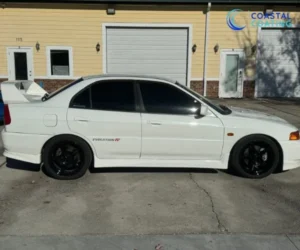
Why Technical Precision Outperforms DIY Methods
Off-the-shelf rubbing compounds and consumer buffers often cause holograms, uneven scouring, or clear coat burn-through. Safe paint restoration relies on controlled processes and specialized resources:
- Professional Expertise: Precision polishing requires controlling panel temperature, machine speed, and pad pressure. Proper technique prevents clear coat burn-through on tight body lines and panel edges.
- High-Quality Products: Utilizing diminishing abrasive polishes and engineered pad materials ensures compounds break down evenly without marring soft paint systems.
- Custom Solutions: Clear coat hardness varies by manufacturer. Testing spots on every vehicle determines the exact pad-and-compound pairing required for specific paint characteristics.
- Local Understanding: Coastal driving in Surfside Beach subjects vehicle surfaces to salt spray, high humidity, and intense sun, requiring targeted paint prep and post-correction sealing strategies.
- Exceptional Service: Detailed panel preparation, masked trim lines, and solvent wipes verify that defects are physically removed rather than temporarily hidden under polishing oils.
Long-Term Protection After Paint Correction
Paint correction leaves a clear coat smooth, clean, and unmasked. Because leveling removes a few microns of material, applying post-correction protection is necessary to prevent recurring oxidation.
While carnauba waxes break down within weeks under heat and sunlight, advanced nano-coatings provide long-term protection:
- Ceramic Coatings: Liquid Silicon Dioxide bonds with a clear coat to form an ultra-hard hydrophobic shield, repelling water, UV radiation, bird drop etching, and salt air.
- Graphene Coatings: Graphene-infused formulas offer high thermal resistance and reduce water spotting on dark finishes exposed to high ambient heat.
Applying a ceramic or graphene coating preserves corrected paint clarity through severe coastal conditions.
People Also Ask
Can all oxidized paint be restored with paint correction?
Most moderate to severe oxidation can be corrected if the clear coat remains intact. If the finish is peeling, flaking, or displaying white patches where the base coat is exposed, paint correction cannot repair the panel, and repainting is required.
How much clear coat is removed during paint correction?
Professional correction removes between 2 to 5 microns of clear coat, a minor fraction of a vehicle’s standard 100 to 150-micron total paint thickness. Pre-polishing digital depth checks ensure safe operation.
What is the difference between car wax and paint correction?
Car wax is a temporary coating that fills minor defects and provides short-term shine. Paint correction is a permanent mechanical process that levels damaged clear coats, physically eliminating swirl marks and oxidation.
How long does paint correction last on a vehicle?
Paint correction results are permanent because defects are physically removed. The duration of the shine depends on subsequent care, maintenance washes, and protective ceramic or graphene coatings.
Protect Your Investment with Coastal Coating
Maintaining vehicle appearance in harsh coastal conditions requires specialized care. At Coastal Coating, we deliver professional paint correction, ceramic coatings, and detailing for cars, boats, RVs, and motorcycles.
Whether you need paint correction in Carolina Forest or protective coatings near Surfside Beach, our team uses professional-grade products and custom processes to protect your property against UV damage and salt air exposure.
Ready to restore clarity and gloss to your vehicle? Contact us today for a free quote.